
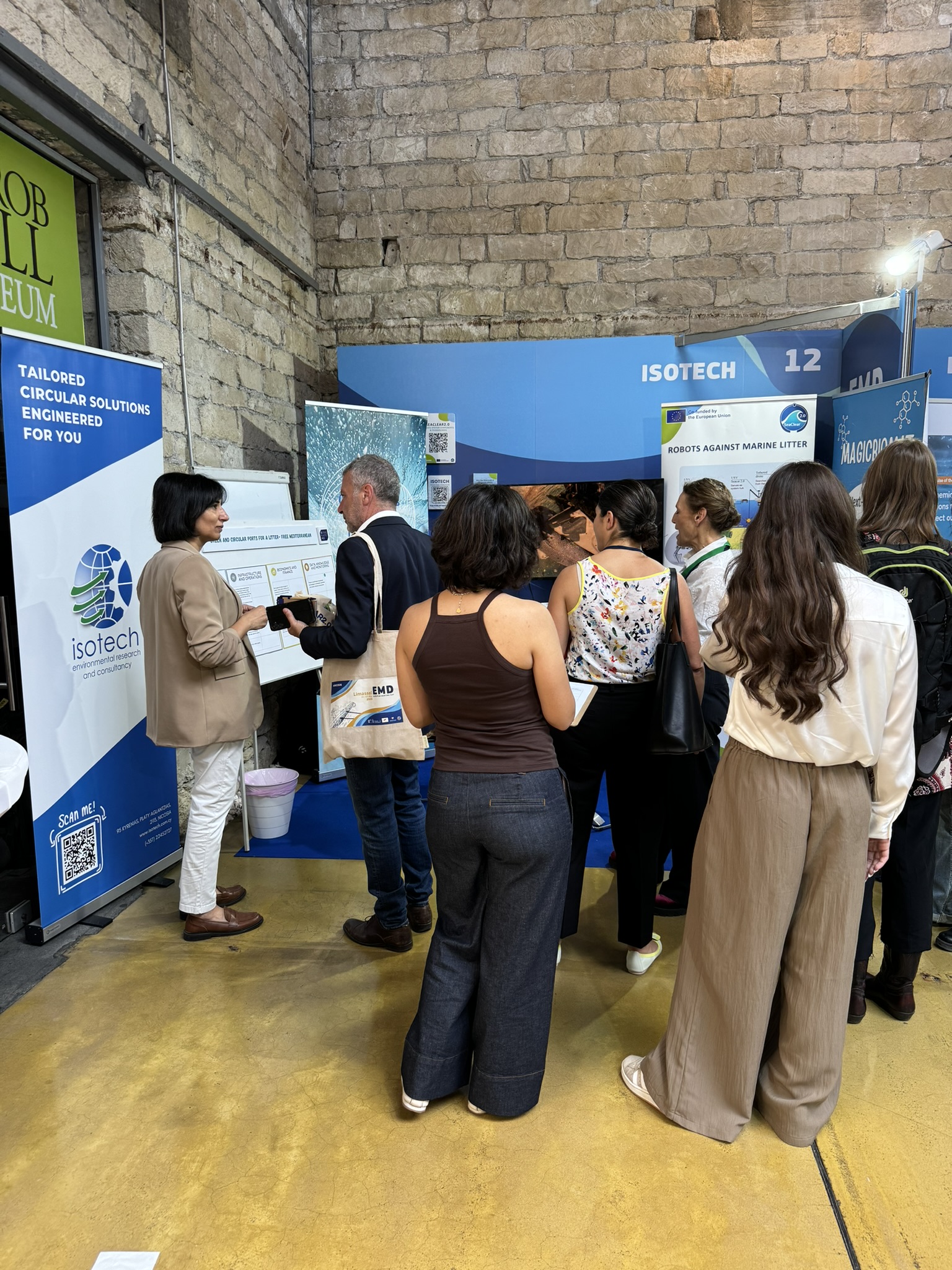
 ISOTECH brought together 55 stakeholders from the marine and maritime sectors across Mediterranean islands and Europe to identify what is really preventing ports from becoming circular at #EMD2026 in Limassol.
ISOTECH led the participatory, collective intelligence process under the project “Green and Circular Ports for a Litter-Free Mediterranean”, supported by the Beyond Plastic Med – BeMed Foundation, exploring barriers across 4 key areas:
 Data, Knowledge & Monitoring
 Infrastructure & Operations
 Economics & Finance
 Governance & Regulation
The results revealed that Mediterranean island ports are not struggling with environmental ambition as much as they are struggling with operational readiness for a circular transition due to systemic challenges.
Governance & Regulation
Under the Governance & Regulation group of challenges, participants highlighted (1) local political limitations and short governance cycles slowing progress and (2) the lack of circular mindsets and long-term strategies within island and city governance systems.
 This highlights how short-term governance structures continue to limit long-term circular transition planning in Mediterranean island contexts.
Infrastructure & Operations
The highest responses under the Infrastructure & Operations group of challenges were: (1) the lack of local infrastructure for reuse, repair and refurbishment activities, and (2) insufficient trained environmental personnel in ports.
The findings indicate that many island ports still do not have the local infrastructure, technical capacity and supporting systems needed to make circular practices function effectively in reality.
Economics & Finance
Under the Economics & Finance group of challenges, stakeholders stressed that (1) reduce-and-reuse models currently lack financial incentives, and (2) upfront implementation costs create resistance among operators and authorities.
In practice, linear systems still remain economically easier to maintain than circular ones.
Data, Knowledge & Monitoring
The most selected challenges across the “Data, Knowledge and Monitoring” axis were (1) the lack of clarity around what circularity in ports actually means in practice beyond decarbonisation and energy efficiency, and (2) insufficient knowledge on materials, quantities and waste streams across ports.
This suggests that many ports still lack practical frameworks, measurable indicators and operational guidance showing how circularity can actually be implemented in everyday port operations.
The main conclusion became clear: The transition toward circular Mediterranean ports is not only a technological challenge. It is a governance, infrastructure and systems challenge requiring coordinated action across the entire maritime sector.
Despite these challenges, Mediterranean island ports have the potential to become hubs of the circular blue economy if supported by the right policies, infrastructure and long-term vision.
ISOTECH brought together 55 stakeholders from the marine and maritime sectors across Mediterranean islands and Europe to identify what is really preventing ports from becoming circular at #EMD2026 in Limassol.
ISOTECH led the participatory, collective intelligence process under the project “Green and Circular Ports for a Litter-Free Mediterranean”, supported by the Beyond Plastic Med – BeMed Foundation, exploring barriers across 4 key areas:
Data, Knowledge & Monitoring
Infrastructure & Operations
Economics & Finance
Governance & Regulation
The results revealed that Mediterranean island ports are not struggling with environmental ambition as much as they are struggling with operational readiness for a circular transition due to systemic challenges.
Governance & Regulation
Under the Governance & Regulation group of challenges, participants highlighted (1) local political limitations and short governance cycles slowing progress and (2) the lack of circular mindsets and long-term strategies within island and city governance systems.
This highlights how short-term governance structures continue to limit long-term circular transition planning in Mediterranean island contexts.
Infrastructure & Operations
The highest responses under the Infrastructure & Operations group of challenges were: (1) the lack of local infrastructure for reuse, repair and refurbishment activities, and (2) insufficient trained environmental personnel in ports.
The findings indicate that many island ports still do not have the local infrastructure, technical capacity and supporting systems needed to make circular practices function effectively in reality.
Economics & Finance
Under the Economics & Finance group of challenges, stakeholders stressed that (1) reduce-and-reuse models currently lack financial incentives, and (2) upfront implementation costs create resistance among operators and authorities.
In practice, linear systems still remain economically easier to maintain than circular ones.
Data, Knowledge & Monitoring
The most selected challenges across the “Data, Knowledge and Monitoring” axis were (1) the lack of clarity around what circularity in ports actually means in practice beyond decarbonisation and energy efficiency, and (2) insufficient knowledge on materials, quantities and waste streams across ports.
This suggests that many ports still lack practical frameworks, measurable indicators and operational guidance showing how circularity can actually be implemented in everyday port operations.
The main conclusion became clear: The transition toward circular Mediterranean ports is not only a technological challenge. It is a governance, infrastructure and systems challenge requiring coordinated action across the entire maritime sector.
Despite these challenges, Mediterranean island ports have the potential to become hubs of the circular blue economy if supported by the right policies, infrastructure and long-term vision.